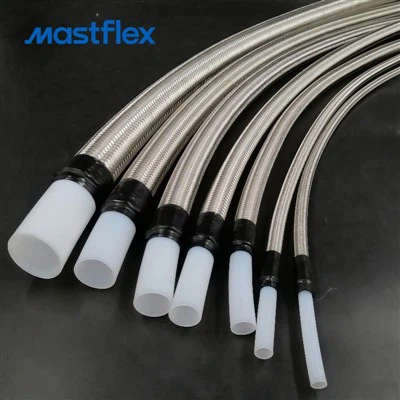
When dealing with PTFE braided hoses, one technical parameter that often comes up is the Poisson's ratio. As a PTFE braided hose supplier, I've received numerous inquiries about this concept. In this blog, I'll delve into what the Poisson's ratio of PTFE braided hose is, its significance, and how it impacts the performance of these hoses.
Understanding Poisson's Ratio
Poisson's ratio is a fundamental material property that describes the relationship between the lateral strain and the axial strain of a material when it is subjected to an external force. When a material is stretched or compressed in one direction (axial direction), it will also deform in the perpendicular (lateral) direction. The Poisson's ratio (ν) is defined as the negative ratio of the lateral strain (ε_transverse) to the axial strain (ε_axial), i.e., ν = - ε_transverse / ε_axial.
For most materials, the Poisson's ratio ranges between 0 and 0.5. A value of 0 indicates that the material does not change its lateral dimensions when subjected to an axial load, while a value of 0.5 implies that the volume of the material remains constant during deformation.
Poisson's Ratio of PTFE
Polytetrafluoroethylene (PTFE) is a well - known fluoropolymer with unique properties. The Poisson's ratio of pure PTFE typically ranges from 0.4 to 0.5. This relatively high value indicates that when PTFE is stretched axially, it contracts significantly in the lateral direction, and vice versa.
The high Poisson's ratio of PTFE is due to its molecular structure. PTFE consists of long chains of carbon atoms with fluorine atoms attached. These chains are held together by weak van der Waals forces. When an external force is applied, the chains can slide past each other, allowing for significant lateral contraction or expansion.
Impact on PTFE Braided Hoses
In the context of PTFE braided hoses, the Poisson's ratio has several important implications:
Dimensional Changes
When a PTFE braided hose is pressurized, it experiences axial and lateral stresses. Due to the high Poisson's ratio of PTFE, the hose will contract laterally as it is stretched axially under pressure. This can lead to a reduction in the inner diameter of the hose, which may affect the flow rate of the fluid passing through it. For example, in applications where precise flow control is required, such as in chemical processing or medical fluid delivery, these dimensional changes need to be carefully considered.


Bending and Flexibility
The Poisson's ratio also influences the bending and flexibility of PTFE braided hoses. When a hose is bent, the outer side of the bend is stretched axially, while the inner side is compressed. The high Poisson's ratio of PTFE causes significant lateral contraction on the outer side and expansion on the inner side. This can affect the overall flexibility of the hose and its ability to withstand repeated bending without damage.
Compatibility with Braiding Materials
PTFE braided hoses are often reinforced with braiding materials such as stainless steel or aramid fibers. The difference in Poisson's ratio between PTFE and the braiding material can lead to stress concentrations at the interface between the two materials. This may result in premature failure of the hose, especially under cyclic loading conditions. Therefore, when designing PTFE braided hoses, it is crucial to select braiding materials with compatible Poisson's ratios to ensure long - term performance.
Applications and Considerations
PTFE braided hoses are widely used in various industries, including chemical, pharmaceutical, food and beverage, and automotive. Each application has its own specific requirements regarding the Poisson's ratio of the hose.
In chemical applications, where aggressive chemicals are transported, the high chemical resistance of PTFE is essential. However, the dimensional changes due to the Poisson's ratio need to be considered to prevent leakage and ensure proper flow. For example, in a chemical transfer system, a PTFE braided hose with a well - understood Poisson's ratio can be selected to maintain a consistent flow rate and prevent any potential chemical spills.
In the food and beverage industry, PTFE braided hoses are used for the transfer of liquids and gases. The Poisson's ratio affects the flexibility of the hose, which is important for easy installation and movement. A hose with the right Poisson's ratio can be bent and routed easily without causing damage to the hose or affecting the flow of the product.
If you are interested in learning more about PTFE hoses, you can visit our website to explore our products. We offer a wide range of Fluoropolymer Tubing, Smooth Bore PTFE Hose, and PTFE Lined Braided Hose.
Conclusion
The Poisson's ratio of PTFE braided hoses is a critical parameter that affects their performance in various applications. Understanding this property is essential for selecting the right hose for a specific application, ensuring proper installation, and predicting the long - term behavior of the hose. As a PTFE braided hose supplier, we are committed to providing high - quality hoses that meet the specific requirements of our customers. If you have any questions about our products or need assistance in selecting the right PTFE braided hose, please feel free to contact us for further discussion and potential procurement.
References
- Callister, W. D., & Rethwisch, D. G. (2010). Materials Science and Engineering: An Introduction. Wiley.
- Brown, R. P. (2005). Fluoropolymers: Synthesis, Properties, and Applications. CRC Press.