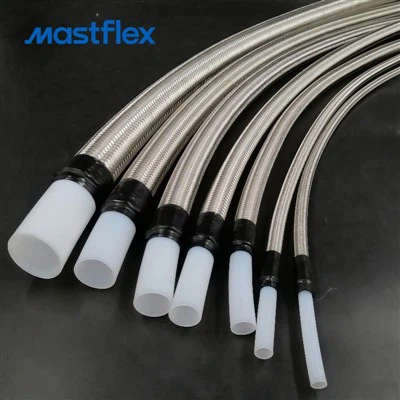
Hey there! As a supplier of PTFE braided hoses, I often get asked about the permeability of these hoses to gases. It's a crucial topic, especially for those who rely on PTFE braided hoses in various applications. So, let's dive right in and explore what the permeability of a PTFE braided hose to gases really means.
What is PTFE and Why is it Used in Hoses?
First off, let's talk a bit about PTFE. PTFE, or polytetrafluoroethylene, is a synthetic fluoropolymer. It's well - known for its outstanding chemical resistance, high temperature tolerance, and low friction coefficient. These properties make it an ideal material for hoses used in a wide range of industries, from chemical processing to food and beverage.
When we talk about PTFE braided hoses, the braiding adds an extra layer of strength and durability. The braiding can be made from materials like stainless steel, which provides additional reinforcement and protection to the PTFE inner tube.
Understanding Gas Permeability
Gas permeability refers to the ability of a material to allow gases to pass through it. In the case of PTFE braided hoses, it's important to know how much gas can permeate through the hose wall over a certain period of time.
The permeability of a PTFE braided hose to gases depends on several factors. One of the key factors is the type of gas. Different gases have different molecular sizes and properties, which affect how easily they can pass through the PTFE material. For example, small molecules like helium can permeate through PTFE more easily than larger molecules like carbon dioxide.
Another factor is the thickness of the PTFE layer. A thicker PTFE layer generally has lower gas permeability because there is more material for the gas molecules to pass through. The temperature also plays a role. As the temperature increases, the gas molecules have more energy and are more likely to pass through the PTFE material, increasing the permeability.
Measuring Gas Permeability
To measure the gas permeability of a PTFE braided hose, we typically use a technique called the gas permeation test. In this test, a sample of the PTFE hose is placed between two chambers. One chamber is filled with the gas of interest, and the other is a vacuum or filled with a different gas. The amount of gas that passes through the hose over a specific period of time is then measured.
The results of these tests are usually expressed in units like cubic centimeters per square meter per day (cc/m²/day). This tells us how much gas can pass through a given area of the hose in a day.
Applications and the Impact of Gas Permeability
In some applications, low gas permeability is crucial. For example, in the pharmaceutical industry, where the purity of the product is of utmost importance, a PTFE braided hose with low gas permeability is essential to prevent contamination from the surrounding gases. Similarly, in the semiconductor industry, where even a small amount of gas permeation can affect the manufacturing process, hoses with low gas permeability are required.
On the other hand, in some applications, a certain level of gas permeability might be acceptable or even desired. For instance, in some ventilation systems, a small amount of gas exchange through the hose can help maintain air quality.
Our PTFE Braided Hose Products
At our company, we offer a variety of PTFE braided hoses to meet different needs. Our Braided PTFE Hose Smooth Bore is a popular choice for applications where a smooth inner surface is required to minimize flow resistance. It has excellent chemical resistance and relatively low gas permeability, making it suitable for many industrial applications.
We also have PTFE Corrugated Hose. The corrugated design provides flexibility, which is useful in applications where the hose needs to be bent or moved. Despite its corrugated structure, it still maintains good gas - impermeability properties.
And our PTFE Hose Assembly is a complete solution that includes the PTFE hose, fittings, and other components. It's designed to be easy to install and use, and we ensure that the gas permeability of the assembly meets the required standards.
Factors We Consider to Control Gas Permeability
As a supplier, we take several steps to control the gas permeability of our PTFE braided hoses. We carefully select the PTFE material, ensuring that it has the right properties for the intended application. We also pay close attention to the manufacturing process. For example, we make sure that the PTFE layer is uniform in thickness, as any variations can affect the gas permeability.
We conduct regular quality control checks using gas permeation tests to ensure that our hoses meet the specified gas permeability standards. If there are any issues, we make the necessary adjustments to the manufacturing process to improve the performance of the hoses.
Contact Us for Your PTFE Braided Hose Needs
If you're in the market for PTFE braided hoses and are concerned about gas permeability, we're here to help. Our team of experts can provide you with detailed information about the gas permeability of our products and help you choose the right hose for your application. Whether you need a hose for a chemical processing plant, a food and beverage facility, or any other industry, we have the solutions for you.
Don't hesitate to reach out to us for a quote or to discuss your specific requirements. We're committed to providing high - quality PTFE braided hoses that meet your needs and exceed your expectations.


References
- ASTM D1434 - Standard Test Method for Determining Gas Permeability Characteristics of Plastic Film and Sheeting.
- "Handbook of Polytetrafluoroethylene (PTFE)" - A comprehensive resource on the properties and applications of PTFE.