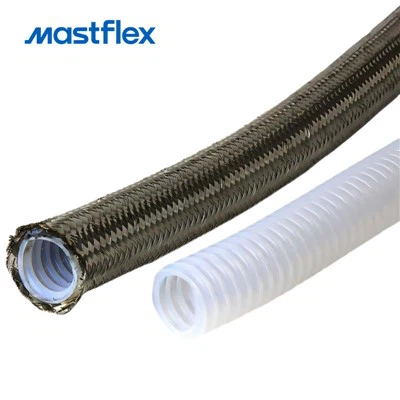
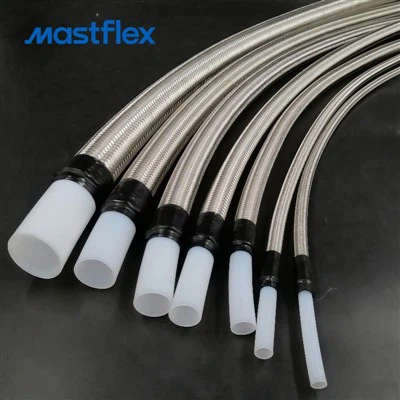
As a PTFE hose supplier, I often receive inquiries about the compressibility of PTFE hoses. Compressibility is a crucial property that affects the performance and application of PTFE hoses in various industries. In this blog post, I will delve into what compressibility means for PTFE hoses, its influencing factors, and its significance in different applications.


Understanding Compressibility in PTFE Hoses
Compressibility refers to the ability of a material to decrease in volume when subjected to an external pressure. In the context of PTFE hoses, it is the measure of how much the hose can be squeezed or compacted under pressure without losing its structural integrity or functionality. PTFE, or polytetrafluoroethylene, is a synthetic fluoropolymer known for its excellent chemical resistance, high temperature tolerance, and low friction coefficient. However, its compressibility is also an important characteristic that can impact its use in different scenarios.
The compressibility of a PTFE hose is typically expressed as a percentage of the original volume that the hose can be compressed to. For example, if a PTFE hose has a compressibility of 10%, it means that under a certain pressure, the hose can be compressed to 90% of its original volume. This property is influenced by several factors, including the material composition, wall thickness, and the design of the hose.
Factors Affecting the Compressibility of PTFE Hoses
Material Composition
The quality and purity of the PTFE used in the hose play a significant role in its compressibility. High - quality PTFE with a uniform molecular structure tends to have better compressibility characteristics. Impurities or additives in the PTFE can affect its ability to compress evenly and may lead to uneven deformation under pressure.
Wall Thickness
The thickness of the PTFE hose wall is another important factor. Thicker walls generally result in lower compressibility because they are more rigid and less likely to deform under pressure. Conversely, thinner - walled PTFE hoses are more compressible but may be less suitable for applications where high pressure resistance is required.
Hose Design
The design of the PTFE hose, such as whether it is smooth - bore or convoluted, also affects its compressibility. Convoluted PTFE Hose has a corrugated structure, which allows it to be more flexible and compressible compared to Braided PTFE Hose Smooth Bore. The convolutions in the hose can collapse under pressure, reducing its volume. On the other hand, smooth - bore hoses are less compressible but offer better flow characteristics.
Significance of Compressibility in Different Applications
Chemical Processing
In chemical processing industries, PTFE hoses are often used to transfer corrosive chemicals. The compressibility of the hose is important because it allows the hose to adapt to changes in pressure and temperature during the transfer process. A compressible PTFE hose can absorb pressure surges without bursting, ensuring the safe and efficient transfer of chemicals.
Food and Beverage Industry
In the food and beverage industry, PTFE hoses are used for the transfer of liquids and gases. Compressibility is crucial in this application as it allows the hose to be easily bent and routed around equipment. This flexibility ensures that the hose can be installed in tight spaces without causing kinks or blockages, which could contaminate the product.
Aerospace and Automotive Applications
In aerospace and automotive applications, PTFE hoses are used for fuel and hydraulic systems. The compressibility of the hose helps to dampen vibrations and absorb shocks, reducing the stress on the hose and the connected components. This improves the reliability and longevity of the system.
Measuring the Compressibility of PTFE Hoses
There are several methods for measuring the compressibility of PTFE hoses. One common method is to use a compression test machine. The hose is placed in the machine, and a known pressure is applied. The change in volume of the hose is then measured, and the compressibility is calculated as a percentage of the original volume.
Another method is to use a pressure - volume curve. This involves measuring the volume of the hose at different pressures and plotting the data on a graph. The slope of the curve indicates the compressibility of the hose.
Compressibility and Hose Selection
When selecting a PTFE hose for a specific application, it is important to consider the compressibility requirements. For applications where high pressure resistance is required, a hose with low compressibility may be more suitable. On the other hand, for applications where flexibility and the ability to absorb pressure surges are important, a more compressible hose may be the better choice.
Fluoropolymer Tubing is also an option to consider. It offers similar properties to PTFE hoses but may have different compressibility characteristics depending on its design and material composition.
Conclusion
The compressibility of a PTFE hose is a complex property that is influenced by several factors, including material composition, wall thickness, and hose design. Understanding the compressibility of PTFE hoses is crucial for selecting the right hose for a specific application. Whether you are in the chemical processing, food and beverage, aerospace, or automotive industry, the compressibility of the PTFE hose can impact its performance and reliability.
If you are in need of PTFE hoses for your business, we are here to help. Our team of experts can assist you in selecting the right PTFE hose based on your specific requirements, including compressibility. Contact us to discuss your needs and start a procurement negotiation. We look forward to working with you to provide high - quality PTFE hoses that meet your exact specifications.
References
- "Handbook of Fluoropolymer Science and Technology"
- "Polytetrafluoroethylene (PTFE) - Properties and Applications"
- Industry standards and guidelines for PTFE hoses