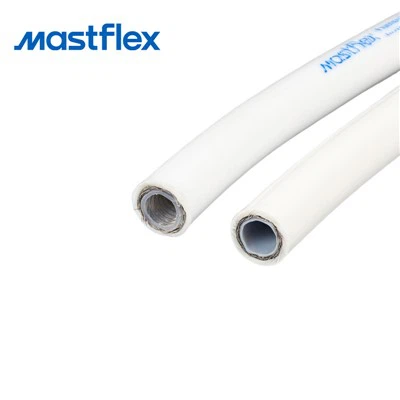
The thermal expansion coefficient of a material is a crucial property, especially when considering its application in various environments. As a PTFE Braided Hose supplier, I understand the significance of this characteristic in ensuring the optimal performance of our products. In this blog, we will delve into the thermal expansion coefficient of PTFE braided hoses, exploring its implications and importance in different scenarios.
Understanding Thermal Expansion
Thermal expansion refers to the tendency of matter to change in volume or length in response to a change in temperature. When a material is heated, its molecules gain energy and move more vigorously, causing the material to expand. Conversely, when cooled, the molecules lose energy and move closer together, resulting in contraction. The thermal expansion coefficient (CTE) is a measure of how much a material expands or contracts per unit length or volume for a given change in temperature. It is typically expressed in units of per degree Celsius (°C⁻¹) or per degree Fahrenheit (°F⁻¹).
Thermal Expansion Coefficient of PTFE
PTFE, or polytetrafluoroethylene, is a synthetic fluoropolymer known for its excellent chemical resistance, low friction coefficient, and high temperature resistance. The thermal expansion coefficient of PTFE is relatively high compared to some other materials. The linear thermal expansion coefficient of PTFE typically ranges from approximately 100 x 10⁻⁶/°C to 200 x 10⁻⁶/°C. This means that for every degree Celsius increase in temperature, a PTFE material will expand by about 100 to 200 parts per million in length.
The relatively high thermal expansion coefficient of PTFE is due to its molecular structure. PTFE has a long, linear chain of carbon atoms with fluorine atoms attached to them. The weak intermolecular forces between these chains allow the molecules to move more freely when heated, resulting in greater expansion.
Implications for PTFE Braided Hoses
For PTFE braided hoses, the thermal expansion coefficient has several important implications:


Installation and Fitting
During installation, it is essential to account for the thermal expansion of PTFE braided hoses. If the hose is installed in a rigid system without allowing for expansion, it can lead to stress on the hose and its connections. This stress can cause leaks, damage to the hose, or even failure of the entire system. To mitigate this risk, proper installation techniques should be employed, such as allowing for sufficient slack in the hose and using flexible connectors.
Temperature Cycling
In applications where the temperature fluctuates significantly, the thermal expansion and contraction of PTFE braided hoses can be a concern. Repeated expansion and contraction can cause fatigue in the hose material, leading to cracks and leaks over time. To address this issue, hoses can be designed with features such as reinforced braiding or additional layers to improve their resistance to temperature cycling.
Compatibility with Other Materials
When using PTFE braided hoses in a system, it is important to consider the thermal expansion coefficients of other materials in the system. If the expansion coefficients of the hose and the surrounding materials are significantly different, it can lead to misalignment, stress, and potential failure. For example, if a PTFE hose is connected to a metal fitting with a much lower thermal expansion coefficient, the difference in expansion can cause the connection to loosen or leak.
Our PTFE Braided Hose Products
As a PTFE Braided Hose supplier, we offer a wide range of products designed to meet the diverse needs of our customers. Our Silicone Covered PTFE Hose provides additional protection against abrasion, heat, and chemicals, while our PTFE Lined Hose offers excellent chemical resistance and low friction. Our Braided PTFE Hose Smooth Bore is ideal for applications where a smooth interior surface is required to minimize fluid flow resistance.
Contact Us for Your PTFE Braided Hose Needs
If you are in the market for high-quality PTFE braided hoses, we invite you to contact us to discuss your specific requirements. Our team of experts can provide you with detailed information about our products, including their thermal expansion coefficients and how they can be best utilized in your applications. We are committed to providing our customers with the best possible products and services, and we look forward to the opportunity to work with you.
References
- "Polytetrafluoroethylene (PTFE) - Properties and Applications," Plastics International.
- "Thermal Expansion of Polymers," Polymer Science Learning Center.