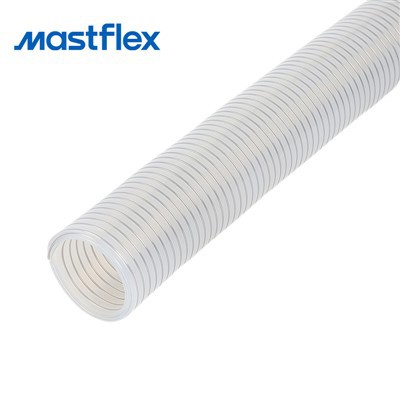
Rebound resilience is a crucial property when it comes to clear silicone tubing, and understanding it can significantly impact various applications. As a supplier of Clear Silicone Tubing, I've witnessed firsthand how this characteristic influences the performance and suitability of the tubing in different scenarios.
What is Rebound Resilience?
Rebound resilience refers to the ability of a material to recover its original shape after being deformed under stress. In the context of clear silicone tubing, it measures how well the tubing can bounce back to its initial form after being compressed, bent, or stretched. This property is essential because it determines the tubing's durability, flexibility, and long - term performance.
When a force is applied to clear silicone tubing, it deforms. The degree of deformation depends on the magnitude of the force and the material's properties. Once the force is removed, the tubing attempts to return to its original shape. The percentage of the original shape that the tubing recovers is known as the rebound resilience. For example, if a piece of tubing is compressed and then recovers 80% of its original shape, its rebound resilience is 80%.


Factors Affecting Rebound Resilience in Clear Silicone Tubing
Several factors can influence the rebound resilience of clear silicone tubing. One of the most significant factors is the formulation of the silicone. Different silicone formulations have different molecular structures, which can affect how the material responds to stress. For instance, a silicone with a higher cross - linking density will generally have better rebound resilience because the cross - links help the material maintain its shape and recover more effectively.
The temperature also plays a crucial role. At lower temperatures, the silicone becomes stiffer, and its rebound resilience decreases. This is because the molecular movement is restricted at low temperatures, making it more difficult for the material to return to its original shape. On the other hand, at higher temperatures, the silicone becomes more flexible, but if the temperature is too high, it can cause the material to degrade, which also affects the rebound resilience.
The manufacturing process is another factor. The way the tubing is extruded, cured, and finished can impact its rebound resilience. For example, proper curing is essential to ensure that the silicone has the right molecular structure and properties. If the curing process is not carried out correctly, the tubing may have poor rebound resilience.
Importance of Rebound Resilience in Different Applications
Medical Applications
In the medical field, clear silicone tubing is widely used for various purposes, such as Silicone Corrugated Breathing Tube and Silicone Oxygen Tubing. Rebound resilience is crucial in these applications because the tubing needs to maintain its shape and flexibility over time. For example, in a breathing tube, if the tubing loses its rebound resilience, it may collapse or kink, which can be life - threatening for the patient. A high rebound resilience ensures that the tubing can withstand repeated bending and compression without losing its functionality.
Bioprocessing
In bioprocessing, Bioprocess Tubing is used for transferring fluids and gases. The rebound resilience of the tubing is important to prevent leakage and ensure a consistent flow. If the tubing does not have good rebound resilience, it may not seal properly, leading to contamination or loss of the fluid or gas being transferred. Additionally, the ability to recover its shape after being bent or compressed allows for easy installation and removal of the tubing in the bioprocessing equipment.
Industrial Applications
In industrial settings, clear silicone tubing is used in various applications, such as fluid transfer, pneumatic systems, and automation. The rebound resilience of the tubing helps it withstand the stresses of continuous use, such as repeated bending, stretching, and compression. This ensures that the tubing can operate reliably over an extended period, reducing the need for frequent replacements and maintenance.
Measuring Rebound Resilience
There are several methods to measure the rebound resilience of clear silicone tubing. One common method is the pendulum method. In this method, a pendulum is dropped onto the tubing, and the height to which the pendulum rebounds is measured. The ratio of the rebound height to the initial drop height is used to calculate the rebound resilience.
Another method is the compression test. In a compression test, a known force is applied to the tubing, and the amount of deformation is measured. After the force is removed, the amount of recovery is measured, and the rebound resilience is calculated as the percentage of the recovery.
How Our Clear Silicone Tubing Ensures High Rebound Resilience
As a supplier of clear silicone tubing, we take several steps to ensure that our products have high rebound resilience. First, we use high - quality silicone formulations that are specifically designed to have excellent mechanical properties, including high rebound resilience. Our formulations are carefully selected and tested to ensure that they meet the highest standards.
We also have a strict manufacturing process. Our tubing is extruded using state - of - the - art equipment, which ensures a uniform wall thickness and consistent properties throughout the tubing. The curing process is carefully controlled to ensure that the silicone has the right molecular structure and properties.
In addition, we conduct extensive quality control tests on our products. Each batch of tubing is tested for rebound resilience and other mechanical properties to ensure that it meets our customers' requirements. We also provide detailed product specifications and technical support to our customers to help them choose the right tubing for their applications.
Conclusion
Rebound resilience is a critical property of clear silicone tubing that affects its performance and suitability in various applications. Understanding the factors that influence rebound resilience and how to measure it is essential for both suppliers and users of the tubing. As a supplier, we are committed to providing high - quality clear silicone tubing with excellent rebound resilience to meet the diverse needs of our customers.
If you are interested in purchasing clear silicone tubing for your specific application, we invite you to contact us for further discussion. Our team of experts is ready to assist you in selecting the right tubing and providing you with the best solutions.
References
- ASTM D1054 - 19 Standard Test Method for Rubber Property - Resilience
- "Silicone Elastomers: Science and Technology" by Clive L. Stanford
- Various industry reports on silicone tubing applications and properties.