


As a supplier of White Silicone Tubing, I often get asked about the thermal conductivity of this product. In this blog post, I'll delve into what thermal conductivity is, the thermal conductivity of white silicone tubing, and how it impacts various applications.
Understanding Thermal Conductivity
Thermal conductivity, denoted by the symbol "k," is a property that describes a material's ability to conduct heat. It is defined as the quantity of heat (in watts) that passes through a unit area (in square meters) of a material per unit thickness (in meters) per unit temperature difference (in Kelvin or Celsius). The SI unit for thermal conductivity is watts per meter - Kelvin (W/(m·K)).
Materials with high thermal conductivity, such as metals like copper and aluminum, can transfer heat rapidly. On the other hand, materials with low thermal conductivity, like plastics and rubber, are considered insulators and impede the flow of heat.
Thermal Conductivity of White Silicone Tubing
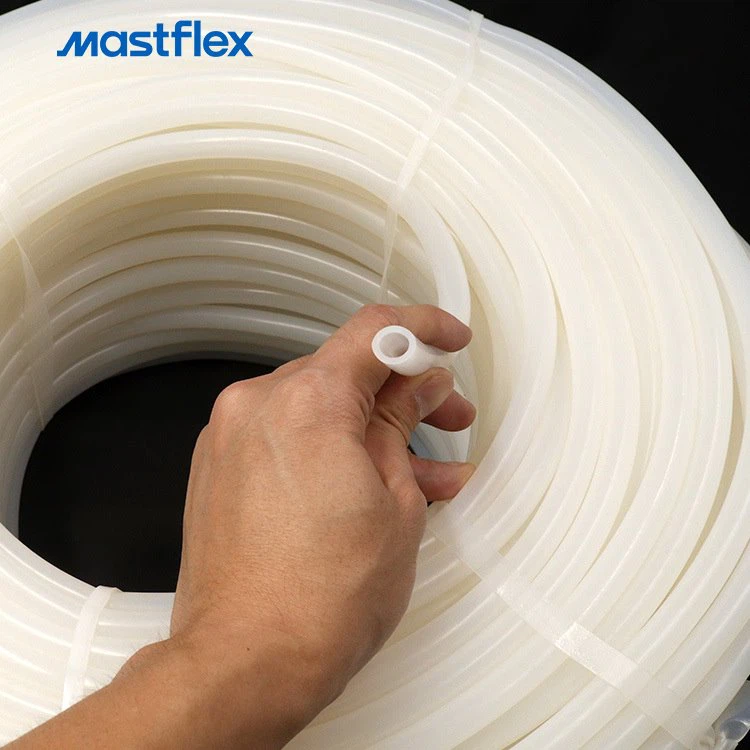
White silicone tubing is made from silicone rubber, which is a polymer with unique properties. Silicone rubber generally has a relatively low thermal conductivity. The thermal conductivity of white silicone tubing typically ranges from 0.1 - 0.2 W/(m·K).
This low thermal conductivity is due to the molecular structure of silicone rubber. The long - chain polymer molecules in silicone rubber have a relatively loose arrangement, and there are few free electrons available for heat transfer. Heat transfer in silicone rubber mainly occurs through molecular vibrations, which is a relatively inefficient process compared to the conduction mechanisms in metals.
Factors Affecting the Thermal Conductivity of White Silicone Tubing
- Filler Content: Silicone tubing can be filled with various additives to enhance certain properties. For example, adding thermally conductive fillers like aluminum oxide or boron nitride can significantly increase the thermal conductivity of the tubing. However, this may also affect other properties such as flexibility and transparency.
- Density: The density of the silicone tubing can influence its thermal conductivity. Generally, a higher - density silicone tubing may have a slightly higher thermal conductivity because the molecules are more closely packed, allowing for more efficient heat transfer through molecular vibrations.
- Temperature: The thermal conductivity of silicone tubing can change with temperature. As the temperature increases, the molecular vibrations in the silicone rubber become more intense, which can lead to a slight increase in thermal conductivity.
Applications Based on Thermal Conductivity
- Insulation Applications: Due to its low thermal conductivity, white silicone tubing is often used in applications where heat insulation is required. For example, in the food and beverage industry, it can be used to transfer hot liquids without significant heat loss to the surrounding environment. You can find our high - quality White Silicone Tubing suitable for such applications.
- Thermal Management in Electronics: Although silicone tubing has low thermal conductivity, it can still play a role in electronics. It can be used to protect wires and components from heat sources, acting as a thermal barrier. Additionally, in some cases where a small amount of heat dissipation is needed, silicone tubing with added thermally conductive fillers can be used.
- Medical Applications: In medical devices, the low thermal conductivity of white silicone tubing is beneficial. It can be used to transfer fluids at specific temperatures without causing significant temperature changes, ensuring the stability of the transferred substances.
Comparison with Other Tubing Materials
- Rubber Tubing: Compared to natural rubber tubing, white silicone tubing generally has better thermal stability and a more consistent thermal conductivity over a wide temperature range. Natural rubber may degrade at high temperatures, which can affect its thermal properties.
- Plastic Tubing: Some plastic tubing materials, such as PVC tubing, may have similar or slightly different thermal conductivities. However, silicone tubing offers better chemical resistance and biocompatibility, making it more suitable for certain applications.
Impact of Braid Reinforcement on Thermal Conductivity
Braid - reinforced silicone tubing, such as our Braid Reinforced Silicone Tubing, is designed to enhance the pressure - bearing capacity of the tubing. The braid material, which is usually made of fibers like polyester or aramid, can have an impact on the thermal conductivity of the tubing.
The braid itself may have a different thermal conductivity compared to the silicone rubber. In most cases, the addition of the braid does not significantly change the overall thermal conductivity of the tubing because the silicone rubber still accounts for the majority of the cross - sectional area through which heat is transferred. However, if the braid material has a very high or low thermal conductivity and is present in a large proportion, it may have a more noticeable effect.
High - Pressure Applications and Thermal Conductivity
In high - pressure applications, our High Pressure FDA Silicone Tubing is often used. The high - pressure environment can potentially affect the thermal conductivity of the tubing. When the tubing is under high pressure, the molecules in the silicone rubber may be compressed, which can lead to a slight increase in thermal conductivity due to the closer packing of the molecules.

However, this effect is usually small, and the overall thermal conductivity of the high - pressure silicone tubing remains within the typical range for silicone rubber.
Importance of Knowing Thermal Conductivity for Customers
For customers, understanding the thermal conductivity of white silicone tubing is crucial for making informed decisions. If they are looking for a tubing material for insulation purposes, a low - thermal - conductivity silicone tubing is the right choice. On the other hand, if they need a tubing material that can dissipate heat to some extent, they may need to consider tubing with added thermally conductive fillers.
Contact for Purchase and Consultation
If you are interested in our white silicone tubing products or have any questions regarding thermal conductivity and its applications, we are here to help. Our team of experts can provide you with detailed information and assist you in selecting the most suitable tubing for your specific needs. We look forward to discussing your requirements and starting a fruitful business relationship.
References
- "Silicone Rubber: Properties and Applications" - A technical publication on silicone rubber materials.
- "Thermal Conductivity of Polymers" - Research paper on the thermal properties of polymer materials.


